Agricultural Robots in 2026: Farming Goes Autonomous
A clear guide to agricultural robots in 2026 — what they are, the types, how they work, the labor crisis driving them, key players, costs, and what's next.
Robotics · Global · 2026-06-28 · 11 min read · By John Awab
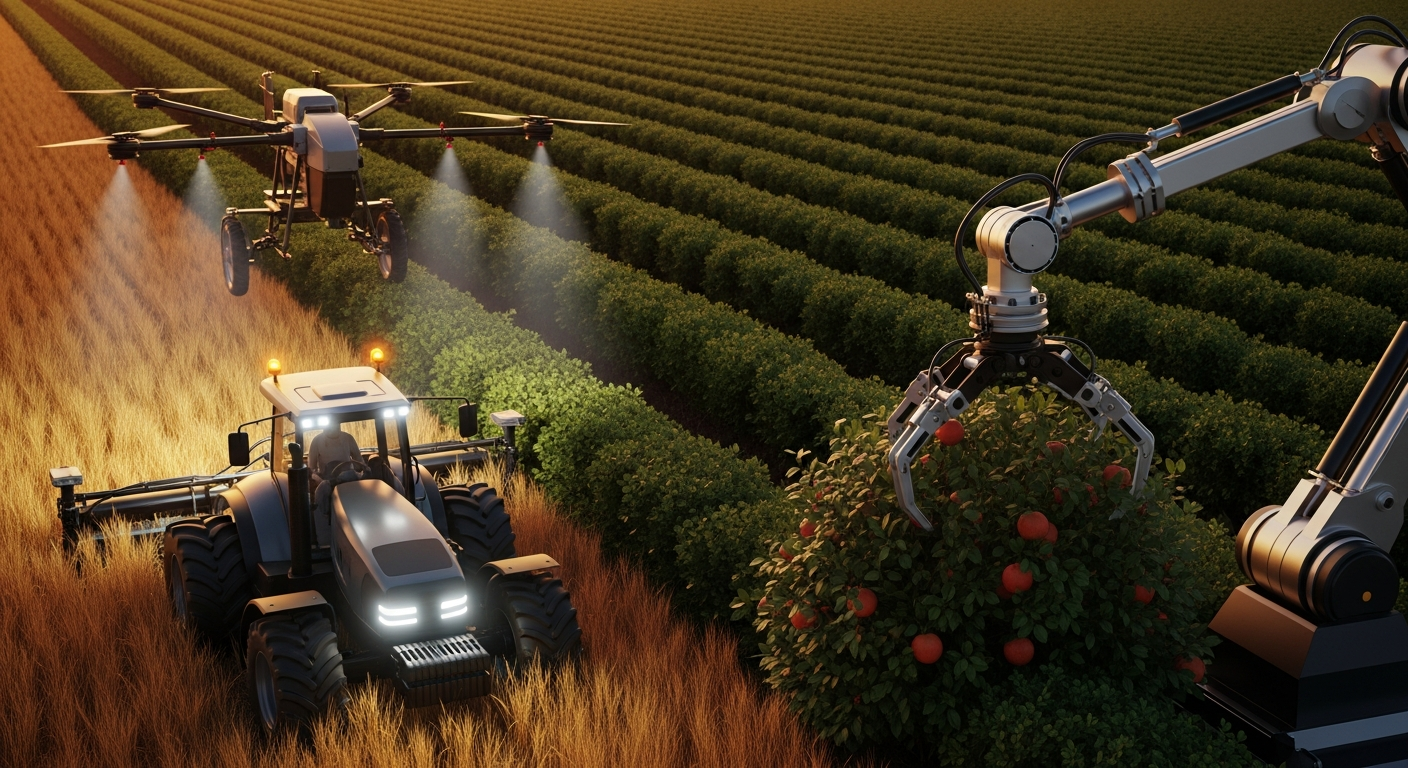
In the American Midwest, driverless tractors now till row crops through the night without anyone in the cab. In specialty fields, robots zap weeds with lasers, cutting herbicide use by up to 80%. On dairy farms, machines milk cows around the clock while monitoring each animal's health. This isn't a distant vision — it's farming in 2026. Driven by a deepening labor crisis and rapid advances in AI and automation, agricultural robots have moved from pilot projects to working fields across America, Europe, and Asia.
This guide explains what agricultural robots are, the main types, how they work, the forces driving their rise, the key players, the business models, and the challenges ahead. (Market figures vary widely by source and scope, so treat them as estimates.)
What Are Agricultural Robots?
Agricultural robots — sometimes called "agribots" or farm robots — are autonomous or semi-autonomous machines that perform farming tasks with little or no human intervention. They span everything from self-driving tractors and crop-spraying drones to fruit-picking harvesters, weeding robots, and automated milking systems. The common thread is using sensors, AI, and automation to handle agricultural work more precisely, consistently, and efficiently than manual labor alone.
The goal isn't to remove farmers but to empower them — letting a smaller workforce produce more food with fewer inputs, less waste, and greater sustainability. As the industry puts it, automation is about doing more with less.
Why Now? The Farm Labor Crisis and More
The single biggest driver is a worsening farm labor shortage. In the US, the number of hired crop workers has fallen sharply, with guest-worker programs unable to fill the gap. In Japan, the farming population is projected to drop below one million by 2030 with an average age over 68, and similar demographic pressures grip Germany, France, and the Netherlands. With fewer people willing to do hard, seasonal farm work, automation has become a practical necessity rather than a luxury.
Other forces reinforce the trend: rising labor costs, the push for precision agriculture to optimize inputs and yields, sustainability mandates to cut chemical and water use, falling sensor and component prices, and new subscription business models that lower the barrier to entry. Together, these have turned agricultural robotics from a research curiosity into a fast-scaling industry.
The Types of Agricultural Robots
Agricultural robots come in several major categories:
- Autonomous tractors — self-driving, GPS-guided tractors that plow, till, sow, and seed around the clock without a driver, a cornerstone of farm automation.
- Agricultural drones — unmanned aircraft that monitor crop health with multispectral cameras and deliver pesticides or nutrients precisely where needed, reducing waste and environmental impact.
- Robotic harvesters — machines using computer vision and gentle manipulators to identify and pick ripe fruits and vegetables like tomatoes, berries, and apples, easing the labor-intensive harvest.
- Weeding and precision-spraying robots — systems that identify and target individual weeds (some using lasers) or spray only where needed, dramatically cutting herbicide use.
- Milking and livestock robots — automated milking systems, feeding machines, and health-monitoring collars that run dairy operations with far less labor.
- Indoor and greenhouse robots — automation for greenhouses and vertical farms, one of the fastest-growing segments.
Most farms will run hybrid fleets, combining traditional, retrofitted, and fully autonomous machines for years to come.
How Agricultural Robots Work
Agricultural robots rely on a fusion of technologies. GPS/GNSS provides centimeter-level positioning for precise navigation and field mapping. LiDAR, radar, and cameras (including multispectral and hyperspectral imaging) let robots sense crops, soil, obstacles, and terrain. Computer vision and AI identify ripe fruit, distinguish crops from weeds, and assess plant health. And increasingly, edge computing processes this data in real time on the machine itself — one of the key reasons performance has improved so dramatically.
A key distinction is the level of autonomy. Fully autonomous robots operate with no driver for entire field cycles, while semi-autonomous systems (the more common type today) automate routine tasks but keep a human available for complex terrain or unexpected situations — a more affordable and reliable approach for many farms.
The Benefits
The advantages are substantial. Agricultural robots address labor shortages by automating work people increasingly won't do. They enable 24/7 operation, working day and night regardless of fatigue. They deliver precision — applying seeds, water, fertilizer, and chemicals exactly where needed, cutting inputs (herbicide reductions of up to 80% in some systems) and costs while protecting the environment. They improve yields and consistency, harvesting gently and uniformly while reducing crop damage.
The Market and Key Players
The agricultural robots market is large and growing fast — estimates place it somewhere in the range of $15–18 billion in 2025–2026, projected to reach roughly $40–56 billion by the early 2030s at compound annual growth rates of around 18–26%, though figures vary considerably by definition. North America leads adoption (driven by large farms and acute labor shortages), while Asia-Pacific is the fastest-growing region. The field blends agricultural-equipment giants with new AI-native startups. John Deere leads with its autonomous tractor lineup and See & Spray precision system. CNH Industrial and AGCO compete with their own autonomous platforms. Among startups, Carbon Robotics has built laser-weeding robots deployed across North America and Europe, Monarch Tractor offers electric, AI-powered autonomous tractors, and Abundant Robotics, Tortuga AgTech, and AppHarvest are tackling robotic harvesting.
Robotics-as-a-Service: The New Business Model
One of the most important shifts is how farmers access these machines. Rather than the daunting upfront cost of buying autonomous equipment outright, Robotics-as-a-Service (RaaS) and "Tractor-as-a-Service" subscription and rental models let farmers pay for automation on an ongoing basis. This lowers the entry barrier, speeds adoption, and keeps machines updated with the latest software. It's also reshaping the industry's economics: software and recurring revenue are becoming as important as hardware sales.
The Challenges
Significant hurdles remain. High upfront cost is the biggest, with an autonomous tractor or dairy robot embedding $100,000–150,000 in mechanical and electronic parts (though RaaS models help). The harsh farm environment — dirt, dust, moisture, and extreme weather — stresses sensitive electronics and sensors. Robots require trained operators and technical support that many farms lack. Regulatory complexity varies country by country, especially for drones and autonomous vehicles on public roads. And while the technology has advanced rapidly, many robotic harvesters still struggle with speed and the enormous variety of crop types and conditions.
The Future
The trajectory points toward broad, full-scale deployment as early adopters prove the return on investment. Expect more capable and affordable machines, the spread of RaaS to small farms, ever-smarter AI and edge computing improving precision and adaptability, and rapid growth in high-value niches like orchard and vineyard automation and greenhouse robotics. Sustainability will remain central, with robots minimizing chemical, water, and energy use. And the line between agriculture and technology continues to blur as software becomes as important as soil.
Conclusion
Agricultural robots are transforming farming from a labor-intensive craft into a precise, data-driven, increasingly autonomous industry. From driverless tractors and crop-spraying drones to robotic harvesters, laser weeders, and automated milkers, these machines are answering a deepening labor crisis while boosting yields, cutting inputs, and improving sustainability.
The market is booming toward tens of billions of dollars, propelled by AI, falling costs, and flexible subscription models that put automation within reach of farms large and small. Real challenges around cost, environment, and maturity remain, but the direction is unmistakable. Understanding agricultural robots reveals how one of humanity's oldest endeavors is being reinvented — feeding a growing world with fewer hands and a lighter footprint.
Want more? Explore AxionSquare for ongoing coverage of agricultural robots, drones, physical AI, and the technologies reshaping how the world works.
Frequently Asked Questions
What are agricultural robots?
Agricultural robots (or "agribots") are autonomous or semi-autonomous machines that perform farming tasks with little human intervention — including self-driving tractors, crop-spraying drones, robotic harvesters, weeding robots, and automated milking systems. They use sensors, AI, and automation to farm more precisely and efficiently.
Why are agricultural robots becoming popular now?
The main driver is a severe farm labor shortage, with declining and aging farm workforces across the US, Japan, and Europe. Rising labor costs, the push for precision agriculture and sustainability, falling sensor prices, and new subscription business models have all accelerated adoption, turning automation into a practical necessity.
What are the main types of agricultural robots?
The major types are autonomous tractors (for plowing, tilling, and seeding), agricultural drones (for crop monitoring and precision spraying), robotic harvesters (for picking fruits and vegetables), weeding and precision-spraying robots, milking and livestock robots, and indoor/greenhouse automation.
How much do agricultural robots cost?
Costs are significant — an autonomous tractor or dairy robot can embed $100,000–150,000 in mechanical and electronic components. However, Robotics-as-a-Service (RaaS) and rental subscription models are making automation far more affordable and accessible, especially for small and mid-sized farms, by spreading costs over time.
Will agricultural robots replace farmers?
The goal is to empower farmers, not replace them — automation helps a shrinking workforce produce more food with fewer inputs amid a labor shortage. Most farms will run hybrid fleets of traditional, retrofitted, and autonomous machines, with humans focusing on higher-value decisions while robots handle repetitive and grueling tasks.