AI in Healthcare: Clinical and Regulatory Frameworks
A review of machine learning applications in diagnostics and drug discovery, including regulatory approval status and clinical benefits.
Artificial Intelligence · Global · 2026-06-26 · 10 min read · By John Awab
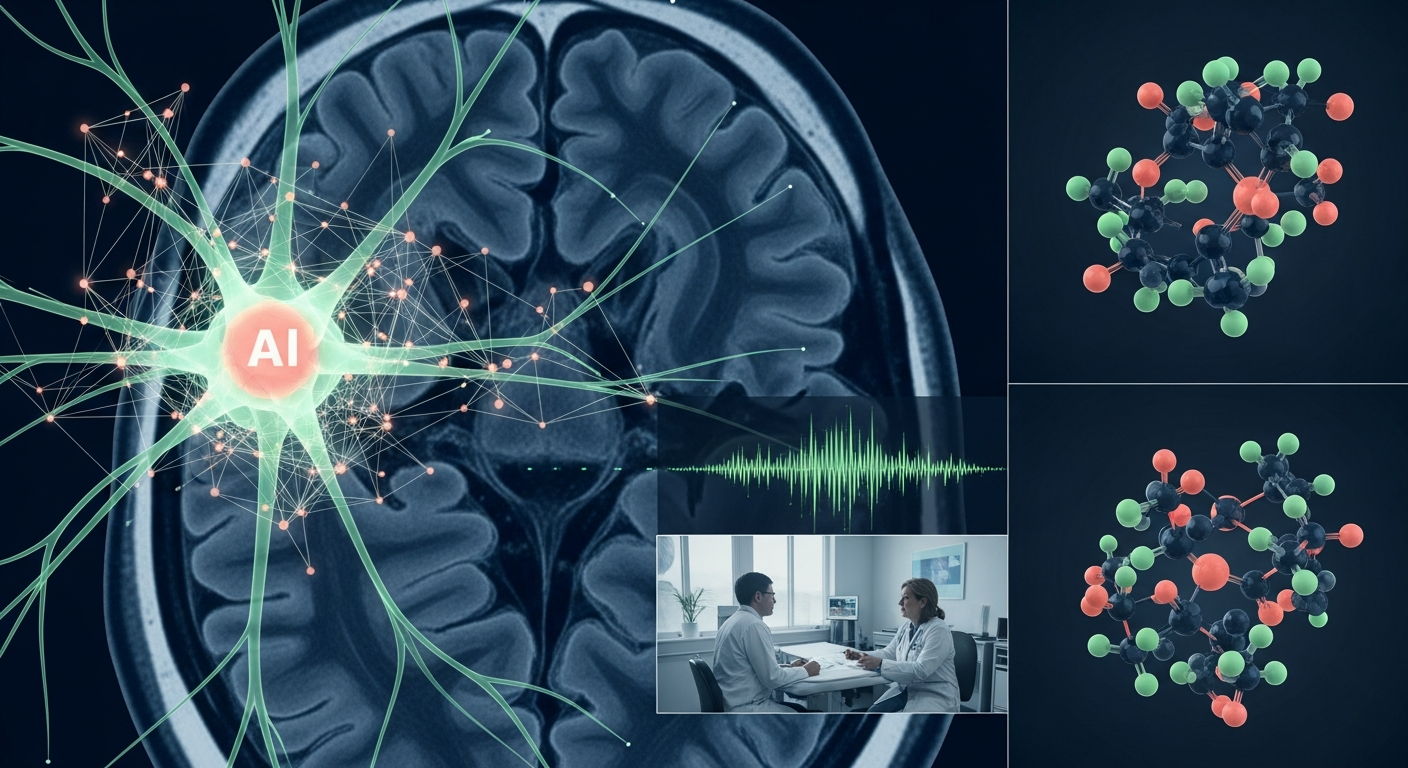
An AI system flags a stroke on a brain scan minutes before a radiologist would have seen it. An ambient assistant listens to a doctor's visit and writes the clinical note automatically, freeing the physician to look the patient in the eye. A pharmaceutical lab uses AI to design a drug candidate in months instead of years. These aren't future scenarios — they're happening now. By 2026, regulators have authorized roughly 950 AI-enabled medical devices, and surveys suggest about two-thirds of physicians now use AI in some form.
This guide explains how AI is used in healthcare, the most impactful applications, the benefits, the serious challenges, and where it's heading. (This is general educational information about technology, not medical advice; always consult qualified healthcare professionals for any health decision.)
Why AI in Healthcare Now?
Several forces have converged. Healthcare generates vast amounts of data — medical images, lab results, genomic data, and digitized records — that AI is uniquely suited to analyze. Advances in deep learning, multimodal models, and large language models have made it possible to interpret that data with remarkable sophistication. At the same time, healthcare faces mounting pressure: clinician burnout, administrative overload, rising costs, and access gaps. AI promises to help on all of these fronts at once.
Medical Imaging and Diagnostics
The most mature application of AI in healthcare is interpreting medical images. AI systems analyzing chest X-rays, mammograms, CT scans, and retinal images have demonstrated diagnostic accuracy equal to or exceeding specialist physicians in controlled studies. In pathology, AI helps examine tissue samples to detect cancer cells and subtle patterns a human might miss. Real deployments exist: tools that flag urgent findings like strokes or bleeds for faster treatment, and digital pathology platforms supporting cancer diagnosis in clinical practice.
Ambient AI and Clinical Documentation
Perhaps the fastest-spreading use of AI in medicine is the least glamorous: paperwork. Clinicians spend an enormous share of their time — by some estimates up to 70% — on administrative tasks, especially documentation. "Ambient AI" scribes listen to a patient visit and automatically draft the clinical note, letting the physician focus on the patient instead of a keyboard. These tools have achieved broad adoption, deployed across many large health systems, powered by specialized healthcare AI companies and major technology platforms.
AI in Drug Discovery
Bringing a new drug to market traditionally takes 10–20 years and enormous cost, with most candidates failing along the way. AI is attacking this at every stage — identifying disease targets, designing molecules, and predicting effectiveness — potentially cutting time and cost substantially. The milestones are striking: one company identified a novel target and advanced a drug candidate in roughly 18 months, a fraction of the usual timeline, and an AI-designed drug has shown promise in early clinical trials.
Clinical Decision Support, Predictive and Personalized Medicine
Beyond imaging and documentation, AI increasingly supports clinical reasoning. Clinical decision support systems integrate multiple data sources — labs, history, vitals, imaging — to suggest possible diagnoses or flag risks, helping clinicians catch what they might otherwise miss. Predictive analytics identify patients at risk of deterioration, readmission, or disease before symptoms become severe, enabling earlier intervention. And personalized (precision) medicine uses genomic and molecular data to tailor treatment to the individual, moving care from population averages toward genuinely personalized therapy.
The Regulatory Landscape
Regulation is central to AI's role in medicine. Health regulators have already authorized hundreds of AI/ML-enabled medical devices and are actively expanding their frameworks — issuing guidance on good practice for AI in drug development, on using AI to support regulatory decisions, and on risk-based evaluation of these tools. This regulatory maturation is what's enabling AI to move from the lab into approved clinical use. But it's an evolving area: ensuring AI tools are safe, effective, and fair across diverse populations remains a work in progress.
The Benefits
The potential upside is substantial. AI can improve diagnostic accuracy and speed, catching disease earlier and reducing errors. It can dramatically cut administrative burden, easing the clinician burnout crisis. It can accelerate drug discovery, bringing treatments to patients faster and at lower cost. It can expand access, extending specialist-level analysis to underserved and resource-limited settings where specialist physicians are scarce. And it can enable personalization, tailoring care to the individual patient's biology and circumstances rather than population averages.
The Challenges
The obstacles are equally serious and must not be glossed over. The deployment gap is real: impressive lab results often don't translate to messy clinical reality, and much AI validation has been retrospective rather than tested in live practice. The "black box" problem — AI that can't explain its reasoning — clashes with medicine's reliance on transparent, evidence-based decisions. Bias is a major concern, as models trained on unrepresentative data can perform unequally across races, genders, and populations, potentially widening health disparities. Data privacy and security are paramount when handling sensitive medical records. And liability, integration, and trust — getting clinicians and patients to rely on AI appropriately — remain ongoing challenges.
Augment, Not Replace
A guiding principle runs through responsible medical AI: these tools are meant to augment clinicians, not replace them. The most effective and safest deployments keep a human in the loop — AI surfaces insights, flags risks, drafts notes, and analyzes data, while trained professionals make the final judgments, bringing context, ethics, and the human connection that medicine requires. Fears of AI replacing doctors miss the more realistic and beneficial picture: AI handling the data-heavy repetitive tasks while humans focus on judgment, empathy, and complex decisions.
The Future
Expect AI to weave ever deeper into healthcare: more capable multimodal and foundation models trained for medicine, broader deployment of ambient documentation and decision support, the first AI-discovered drugs reaching patients, digital twins reshaping clinical trials, and AI extending care into homes through remote monitoring and wearables. As regulatory frameworks mature and validation improves, tools now confined to research will move into routine practice. The trajectory points toward AI as a standard part of clinical infrastructure.
Conclusion
AI in healthcare has crossed from promise into practice — reading scans, drafting clinical notes, discovering drugs, predicting risk, and personalizing treatment. With hundreds of approved AI medical devices and most physicians already using AI in some form, the technology is genuinely reshaping medicine, even as its most ambitious applications remain works in progress.
The benefits — better diagnostics, less burnout, faster cures, wider access — are profound, but so are the challenges of bias, transparency, privacy, validation, and trust. The guiding principle is augmentation, not replacement: AI as a powerful tool in skilled human hands. Understanding how AI is transforming healthcare reveals one of the most consequential applications of the technology anywhere. As always, this is general information, not medical advice — consult qualified healthcare professionals for any health decision.
Want more? Explore AxionSquare for ongoing coverage of AI in healthcare, machine learning, and the technologies shaping the future.
Frequently Asked Questions
How is AI used in healthcare?
AI is used to interpret medical images and aid diagnosis, draft clinical notes through ambient documentation, discover and design new drugs, support clinical decisions, predict patient risk, personalize treatment via genomics, and streamline administrative tasks. Medical imaging and documentation are among the most mature, widely deployed uses.
Is AI in healthcare safe and approved?
Regulators have authorized roughly 950 AI-enabled medical devices and are expanding frameworks to evaluate them. However, many tools remain validated mainly in research settings, and ensuring safety, real-world effectiveness, and performance across diverse populations is an ongoing process. Approved tools are used to support, not replace, clinical judgment.
Will AI replace doctors?
The realistic and intended role of AI is to augment clinicians, not replace them. AI handles data-heavy, repetitive, and pattern-recognition tasks — analyzing scans, drafting notes, flagging risks — while trained professionals make final decisions, providing context, ethics, and human connection. The most effective deployments keep a human in the loop.
How is AI used in drug discovery?
AI helps identify disease targets, design candidate molecules, and predict effectiveness, potentially cutting development time and cost substantially. Tools like AlphaFold predict protein structures, and companies have advanced AI-designed drug candidates far faster than traditional methods. The first approvals of fully AI-discovered drugs are anticipated in the coming years.
What are the biggest challenges of AI in healthcare?
Key challenges include the deployment gap (lab results not translating to clinical reality), the "black box" lack of explainability, bias from unrepresentative training data, patient data privacy and security, integration into workflows, liability, and earning clinician and patient trust. Rigorous validation and responsible deployment are essential.
Sources and further reading
- FDA Digital Health Center of Excellence — Regulatory status and framework for AI-enabled medical devices