DeFi in 2026: Decentralized Finance Explained
A clear guide to DeFi in 2026 — what decentralized finance is, how it works, DEXs, lending, RWA tokenization, the institutional shift, the risks, and what's next.
Fintech · Global · 2026-07-03 · 11 min read · By John Awab
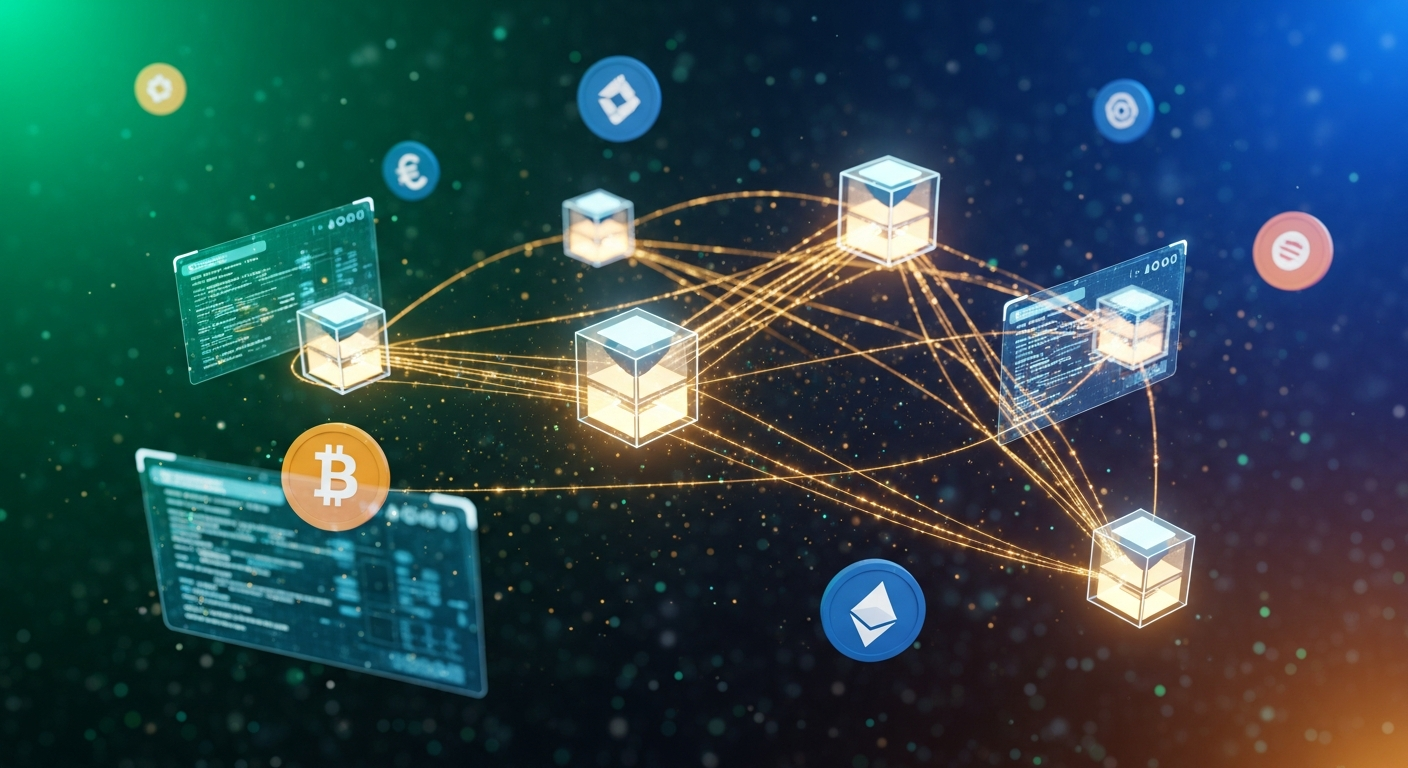
Imagine lending money, borrowing against your assets, trading currencies, or earning yield — all without a bank, broker, or any middleman, using nothing but code running on a blockchain. That's decentralized finance, or DeFi: an attempt to rebuild the financial system on open, programmable, permissionless infrastructure. Once a fringe crypto experiment, DeFi has matured into a substantial ecosystem holding tens of billions of dollars, and in 2026 it's crossing a pivotal threshold as institutions like BlackRock bring real-world assets on-chain and regulators begin drawing clearer lines. The technology that promised to reinvent finance is starting to intersect with the mainstream financial system it set out to disrupt.
This guide explains what DeFi is, how it works, its core building blocks, the rise of real-world asset tokenization, the 2026 institutional shift, and the very real risks. (DeFi is highly volatile, experimental, and risky; this is general educational information, not financial advice.)
What Is DeFi?
Decentralized finance (DeFi) is a system of financial services — lending, borrowing, trading, earning yield, and more — built on blockchains using smart contracts, without traditional intermediaries like banks or brokers. Instead of a company controlling your money and the rules, self-executing code (smart contracts) handles transactions automatically and transparently, and users keep custody of their own assets in crypto wallets.
The core promise is a financial system that's open to anyone with an internet connection, transparent (transactions are recorded on a public ledger), and permissionless (no gatekeeper decides who can participate). DeFi mostly runs on Ethereum and other programmable blockchains, forming an interconnected ecosystem of applications that can be combined like building blocks.
DeFi vs Traditional Finance
The contrast with traditional finance (often called TradFi) — and even with centralized crypto exchanges (CeFi) — is stark. In traditional finance, a bank or broker holds your funds, controls the order book, sets the rules, and acts as gatekeeper; if it's breached, mismanaged, or shut down, you're affected. In DeFi, there's no single controlling entity — smart contracts and liquidity pools replace the intermediary, you self-custody your assets, and the system runs 24/7 without permission. The trade-off is fundamental: DeFi offers openness, transparency, and control, but removes the safety nets, customer service, and recourse that regulated institutions provide. There's no bank to call if something goes wrong.
How DeFi Works
Several technologies combine to make DeFi function. The foundation is a blockchain (predominantly Ethereum) — a transparent, distributed ledger. On top sit smart contracts, self-executing programs that automatically carry out financial functions like swapping tokens or issuing loans when conditions are met. Users interact through self-custodial wallets (such as MetaMask) that hold their assets and connect to applications. Trading and lending rely on liquidity pools — pools of tokens supplied by users that others can trade against or borrow from, priced by algorithms called automated market makers. And oracles feed real-world data (like asset prices) into smart contracts. Together, these let financial services run automatically, without a central operator.
The Building Blocks of DeFi
DeFi is composed of interoperable "money legos" — protocols that each handle a financial function and can be combined:
- Decentralized exchanges (DEXs) let users swap tokens directly from their wallets using smart contracts and liquidity pools instead of a centralized order book. Leaders include Uniswap and Curve, with DEX trading now representing a significant and rising share of all crypto trading.
- Lending and borrowing protocols let users deposit crypto to earn interest or borrow against collateral, all algorithmically. This is among the largest DeFi categories, led by protocols like Aave, Compound, and Morpho.
- Liquid staking lets users stake crypto to help secure a network while receiving a liquid token they can use elsewhere — a fast-growing segment led by Lido, with "restaking" protocols like EigenLayer adding another layer.
- Yield farming and aggregators optimize returns by moving assets across protocols.
- Stablecoins — crypto tokens pegged to currencies like the dollar — serve as the primary medium of exchange and settlement across DeFi, increasingly in yield-bearing forms.
- Derivatives and insurance protocols round out the ecosystem.
The total value users have deposited across these protocols — the key health metric known as Total Value Locked (TVL) — sits in the range of tens to over a hundred billion dollars in 2026, though it fluctuates significantly with market cycles.
The Rise of Real-World Asset Tokenization
The most consequential DeFi trend in 2026 is real-world asset (RWA) tokenization — creating blockchain tokens that represent ownership of physical or financial assets like Treasuries, bonds, credit, and commodities. This brings traditional assets on-chain, where they gain faster settlement, greater transparency, and programmability, while giving DeFi access to stable, yield-generating collateral. The category has grown into one of DeFi's largest, with billions in tokenized US Treasuries alone. The landmark moment came when the world's largest asset manager listed its tokenized Treasury fund on a decentralized exchange and even took a stake in a DeFi protocol's governance — a striking signal of convergence. Platforms like Ondo and Centrifuge specialize in bridging real-world cash flows into DeFi, and RWA tokenization is now the fastest-growing part of the ecosystem, blurring the line between traditional and decentralized finance.
DeFi in 2026: Institutions Arrive
If DeFi's early years were driven by speculation, 2026 is defined by institutionalization. Major asset managers are tokenizing funds, traditional financial firms are launching stablecoins and exploring on-chain settlement, and regulated products like crypto ETFs are drawing institutional capital into the space. A telling milestone: DeFi applications now generate more fees than the underlying blockchains they run on — a sign the industry is maturing from infrastructure-building to real economic activity. Meanwhile, Layer-2 scaling technologies have slashed transaction costs, making frequent, smaller transactions practical, and "permissioned" DeFi venues are emerging to let institutions participate while meeting compliance requirements. The center of gravity is shifting from purely speculative activity toward regulated, utility-driven adoption.
The Benefits
DeFi's advantages are genuine. Open access means anyone with an internet connection can use financial services without a bank account or approval. Self-custody gives users full control of their assets rather than trusting a third party. Transparency lets anyone verify transactions and protocol reserves on-chain. Composability — the ability to plug protocols together like building blocks — enables rapid financial innovation. And DeFi operates globally and around the clock, offering yield opportunities and services to people underserved by traditional finance. For its proponents, DeFi represents a more open, efficient, and inclusive financial system.
The Risks
The risks, however, are serious and must not be understated. Smart contract vulnerabilities are a constant danger — bugs and exploits have drained enormous sums, with billions lost to hacks in recent years; in one 2026 incident, a single protocol lost hundreds of millions, over half its deposited value, in a matter of hours. Volatility is extreme, and collateral can be liquidated fast in a downturn. No recourse exists — there's no FDIC insurance, no fraud department, and mistakes are often irreversible. Systemic contagion is a growing concern as interconnected protocols mean stress in one can spread quickly. And scams like "rug pulls" prey on inexperienced users. DeFi is powerful but unforgiving; it demands genuine understanding and caution, and users should never commit more than they can afford to lose entirely.
The Regulatory Question
Regulation is DeFi's great unresolved question. Frameworks are advancing — Europe's MiCA rules are being enforced, and the US regulatory tone has shifted toward encouraging compliant digital-asset activity — but a fundamental challenge remains: how do you regulate a system designed to have no central operator? No major jurisdiction has decisively resolved "how decentralized is decentralized enough" to escape traditional oversight. The result is a two-track environment where compliant, institution-friendly venues operate under stricter rules while offshore platforms retain looser practices. How regulators ultimately treat DeFi — and whether they can do so without destroying its permissionless nature — will profoundly shape its future.
The Future
DeFi's trajectory points toward deeper integration with mainstream finance, driven by RWA tokenization, institutional adoption, regulatory clarity, and cheaper, faster infrastructure. Expect more traditional assets to move on-chain, more institutions to participate through compliant channels, and continued maturation from speculation toward utility. At the same time, the ecosystem must confront its security and systemic risks and resolve the regulatory question. Whether DeFi ultimately transforms finance or settles into a specialized niche alongside traditional systems, its core innovations — programmable money, self-custody, and open access — are already reshaping how the financial world thinks about infrastructure.
Conclusion
DeFi reimagines finance as open, programmable, and intermediary-free — letting people lend, borrow, trade, and earn yield through smart contracts on a blockchain rather than through banks. Built from composable building blocks like decentralized exchanges, lending protocols, and liquid staking, and increasingly bridging to real-world assets, it has grown into a substantial ecosystem that in 2026 is drawing serious institutional interest.
But DeFi's openness comes without the safety nets of traditional finance, and its risks — exploits, volatility, systemic contagion, and regulatory uncertainty — are as real as its promise. Understanding how DeFi works, what it enables, and where it can go wrong is essential to navigating one of fintech's most ambitious and consequential frontiers. As always, this is general information, not financial advice — do your own research and never risk more than you can afford to lose.
Want more? Explore AxionSquare for ongoing coverage of DeFi, blockchain, stablecoins, and the future of money.
Frequently Asked Questions
What is DeFi (decentralized finance)?
DeFi is a system of financial services — lending, borrowing, trading, and earning yield — built on blockchains using smart contracts, without traditional intermediaries like banks or brokers. Self-executing code handles transactions transparently, and users keep custody of their own assets in crypto wallets. It aims to be open, transparent, and permissionless.
How is DeFi different from traditional finance?
In traditional finance, a bank or broker holds your funds, controls the rules, and acts as gatekeeper. In DeFi, smart contracts and liquidity pools replace the intermediary, you self-custody your assets, and the system runs 24/7 without permission. The trade-off: DeFi offers openness and control but removes the safety nets, insurance, and recourse of regulated institutions.
What are the main parts of DeFi?
Key building blocks include decentralized exchanges (DEXs) like Uniswap for swapping tokens, lending and borrowing protocols like Aave and Compound, liquid staking led by Lido, yield farming and aggregators, stablecoins as the settlement medium, and increasingly real-world asset (RWA) tokenization. These composable "money legos" can be combined into complex financial applications.
Is DeFi safe?
DeFi carries serious risks. Smart contract bugs and exploits have drained billions, there's extreme volatility, no FDIC insurance or recourse if something goes wrong, and growing systemic contagion risk as protocols interconnect. Scams like "rug pulls" also target newcomers. DeFi can be powerful but is unforgiving — never commit more than you can afford to lose entirely.
What is real-world asset (RWA) tokenization?
RWA tokenization creates blockchain tokens representing ownership of physical or financial assets like US Treasuries, bonds, and commodities. It brings traditional assets on-chain for faster settlement, transparency, and programmability, while giving DeFi stable, yield-generating collateral. It's the fastest-growing DeFi trend in 2026, exemplified by major asset managers tokenizing funds.