Delivery Robots in 2026: Last-Mile Goes Autonomous
A clear guide to delivery robots in 2026 — how sidewalk robots work, the key players, the economics of last-mile, regulation, accessibility debates, and what's next.
Robotics · Global · 2026-07-09 · 9 min read · By John Awab
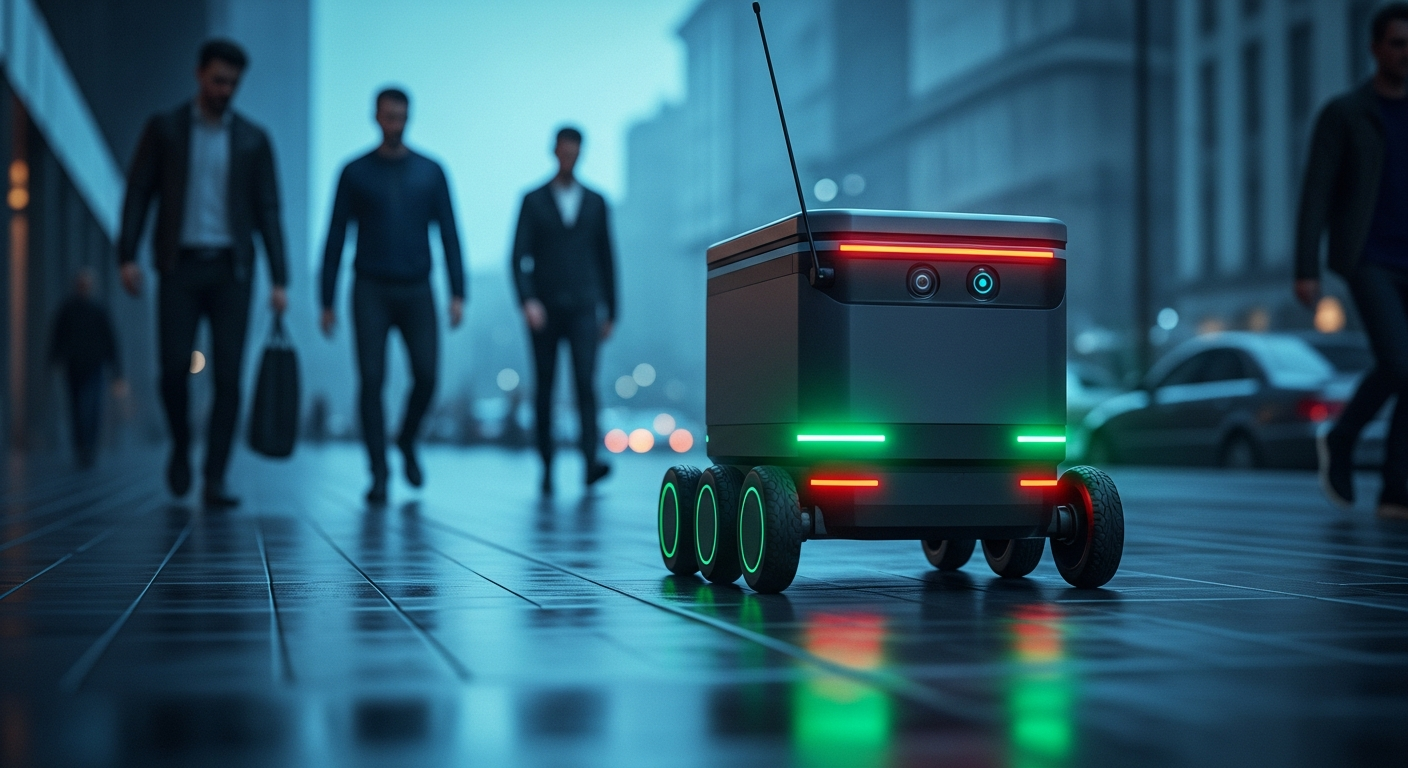
A cooler-sized box on six wheels rolls down the sidewalk, pauses at a crosswalk, waits for traffic to clear, and continues on its way carrying someone's dinner. A few years ago this was a curiosity, worth stopping to photograph. In 2026 it's infrastructure: one operator alone has completed over 10 million autonomous deliveries with a fleet of more than 3,000 robots across eight countries, performing roughly two road crossings every second. Delivery robots have crossed the line from novelty to necessity.
This guide explains what delivery robots are, why the last mile matters so much, how they work, the key players, the economics, the regulatory patchwork, the real controversies, and where the technology is heading. (Market figures vary widely by source and scope, so treat them as estimates.)
What Are Delivery Robots?
Delivery robots are autonomous ground vehicles that transport goods — food, groceries, parcels, medications — from a local hub or store to a customer's door without a human driver. The most familiar form is the sidewalk robot: a small, slow, electric, wheeled device that navigates pedestrian paths at walking speed. But the category is broader, spanning several form factors suited to different jobs.
What unites them is a target: the "last mile," the final leg of a delivery journey. It's the part of logistics most resistant to automation and, until recently, most resistant to change.
Why the Last Mile Is the Prize
The last mile is famously the most expensive segment of the supply chain — by common industry estimates it can account for around half of total shipping costs. It's labor-intensive (a human driver per delivery), inefficient (vans idling, circling for parking), and slow in congested cities. That cost structure is exactly what autonomous delivery targets.
The potential savings are striking. Where a human courier delivery might cost several dollars, robot deliveries at scale are claimed to cost a fraction of that — though these figures come from operators and vary enormously with fleet density, route type, and how you account for support staff and teleoperation. Add environmental benefits — academic studies suggest sidewalk robots could cut energy use by 40%+ versus traditional couriers, and one operator reports avoiding millions of kilograms of CO₂ annually — and the pitch to cities and retailers is compelling.
The Types of Delivery Robots
Several distinct approaches attack different versions of the last-mile problem:
- Sidewalk robots — small, cooler-sized units operating at walking speed on pedestrian paths, ideal for restaurant, grocery, and convenience deliveries in dense neighborhoods and on campuses. They dominate the market, holding the majority share of deployments.
- On-road autonomous delivery vehicles — larger, car-sized platforms that carry bigger loads on roads, better suited to suburban grocery runs and higher-volume routes, operating at Level 4 autonomy within defined zones.
- Delivery drones — aerial vehicles for speed-critical, lightweight payloads, complementing ground robots where airspace permits.
- Indoor and intra-facility robots — increasingly used in hospitals; in Japan, where an aging population strains nursing staff, one hospital robot reportedly averages 170 medication runs per day.
Most real-world operations are hybrid: robots handle short, repetitive loops while human couriers handle complex, long, or awkward deliveries. This complementary model — not full replacement — has become the industry standard.
How Delivery Robots Work
Under the hood, a delivery robot is a compact autonomous vehicle. It perceives the world through sensor fusion — combining cameras, LiDAR, radar, and ultrasonic sensors — and navigates using visual SLAM (simultaneous localization and mapping) to build and track its position in a map of the environment. Edge computing processes this data onboard for fast, safe decisions, while AI and machine learning handle pedestrian avoidance, curb detection, and crossing decisions in real time.
Leading fleets now operate at Level 4 autonomy — driving themselves without active human supervision within their operating areas — while keeping remote support available for edge cases. A telling detail of engineering maturity: early robots struggled with simple curbs, while modern units use suspension designs to handle obstacles, and typically carry payloads around 12–20 kg with ranges of roughly 15 km per charge.
Two Sensor Philosophies
As in robotaxis, the industry has split on sensors. LiDAR-centric designs offer millimeter-precision mapping but raise the cost per robot substantially. Vision-first approaches use cameras and cheaper sensors, betting that computer vision alone can achieve urban reliability — and at least one operator has reached profitability on a comparatively lean funding base with this strategy. Newer ultrasonic and vision-based sensor suites can reportedly cut hardware costs dramatically, though the tradeoff in challenging lighting and weather conditions remains an active engineering debate.
The Key Players
The delivery-robot market is notably fragmented — the top vendors together hold only a modest share of installed fleets — and the landscape features:
- Starship Technologies, founded in 2014 by Skype co-founders, pioneered the commercial sidewalk robot and is now the largest operator, with 10M+ deliveries, 3,000+ robots, 300+ locations across eight countries, and tens of millions of autonomous kilometers.
- Serve Robotics (spun out of Postmates, backed by Uber and NVIDIA) runs box-shaped robots in dense US cities including Los Angeles, Miami, Dallas, and Chicago, partnering with Uber Eats and DoorDash, and is publicly traded.
- Cartken proves the vision-only, low-cost thesis; Coco and Avride compete in the sidewalk segment; Yango/Noon deploys hub-and-spoke fleets across the Middle East and Southeast Asia.
- Nuro builds larger on-road delivery vehicles for heavier loads.
- DoorDash launched its own robot, "Dot," designed to handle bike lanes, sidewalks, roads, and driveways.
- Regional giants — JD.com and Alibaba in China, DHL and Hermes piloting in Germany — round out a global field.
A cautionary tale sits alongside them: Amazon ended its Scout program in 2022 after concluding it couldn't scale as hoped, despite Scout's early work helping define the sidewalk-robot blueprint. Autonomy alone was never sufficient — reliability, regulation, and public trust matter just as much.
The Market
Estimates place the autonomous delivery robot market in the low single-digit billions of dollars in 2026, growing at roughly 20–32% annually toward several billion by the early 2030s — though figures vary substantially by definition and scope. Outdoor sidewalk robots lead by share, while grocery and convenience deliveries are among the fastest-growing segments. North America dominates (led by the US, with its e-commerce scale, tech ecosystem, and permissive state laws), while Asia Pacific grows fastest, propelled by China's logistics giants and Japan's demographic push to automate care and delivery.
Regulation: A Patchwork
Rules vary enormously by jurisdiction. In the United States, a large majority of states have enacted laws permitting sidewalk robots — often classifying them as "Personal Delivery Devices" (PDDs) — with typical requirements around maximum weight, speed caps (commonly 6–12 mph), pedestrian right-of-way, liability insurance, and remote teleoperation capability. Some states legally define PDDs as pedestrians. Japan amended its road traffic law to legalize remote-controlled delivery robots in public spaces. South Korea passed enabling legislation with requirements for insurance and remote monitoring capability.
But regulation remains a patchwork: rules differ city by city and country by country, creating a compliance maze that slows scaling for any operator trying to cross borders. The multi-jurisdiction complexity is one of the sector's least-discussed growth constraints.
The Controversies
Delivery robots face genuine, unresolved criticism. The most serious concerns accessibility: disability-rights advocates argue that robots occupying sidewalks obstruct wheelchair users and conflict with accessibility standards, and cities including Toronto have banned them on those grounds. There's a legitimate debate here about who public sidewalks are for, and reasonable people disagree about how to balance innovation against accessibility.
Other challenges include theft and vandalism (robots are robbed and knocked over far more than operators publicly admit), privacy from camera-equipped robots traversing residential streets, sidewalk clutter in already-crowded urban cores, and the political economy of job displacement for the millions of people currently employed in delivery work. None of these have been cleanly resolved.
The Future
The trajectory points toward larger fleets, cheaper hardware, and deeper integration. Expect sensor costs to fall — especially as vision-first approaches mature — fleets to scale toward profitability thresholds, improved human-robot interaction and accessibility design, tighter integration with smart-city infrastructure, and orchestrated multimodal systems where robots, drones, cargo e-bikes, and EV vans work together under unified fleet-management software. Regulation will likely converge toward more permissive frameworks as commercial deployments build safety records, though accessibility requirements will force meaningful design changes on the leading operators.
Conclusion
Delivery robots have quietly moved from novelty to necessity, tackling the last mile — logistics' most expensive, labor-intensive bottleneck — with small autonomous vehicles that navigate sidewalks at walking speed. Led by Starship's 10-million-delivery milestone and a fragmented field of competitors, powered by sensor fusion, visual SLAM, and edge AI, and boosted by compelling cost and emissions math, the sector has reached genuine commercial scale.
Real obstacles remain: fragmented regulation, sensor costs, sidewalk accessibility disputes, theft, and economics that only work in the right markets. But the direction is clear. In a hybrid future where robots handle the simple loops and humans handle the rest, the last mile is finally, and quietly, going autonomous.
Want more? Explore AxionSquare for ongoing coverage of robotics, autonomous vehicles, and the technologies moving the world.
What are delivery robots?
Delivery robots are autonomous ground vehicles that transport goods — food, groceries, parcels, medications — from a local hub to a customer's door without a human driver. The most common form is the sidewalk robot: a small, slow, electric, wheeled device navigating pedestrian paths at walking speed. On-road vehicles and drones serve related roles.
How do delivery robots work?
They use sensor fusion (cameras, LiDAR, radar, ultrasonic sensors) and visual SLAM to map and navigate their surroundings, with edge computing processing data onboard and AI handling pedestrian avoidance and crossing decisions. Leading fleets operate at Level 4 autonomy without active supervision, with remote human teleoperators available for edge cases.
Are delivery robots cheaper than human couriers?
At sufficient scale and density, robot deliveries are claimed to cost a fraction of a human courier delivery, which is why the last mile — roughly half of total shipping cost — is such an attractive target. But these figures come from operators and depend heavily on fleet density, route type, and support costs. In markets with inexpensive labor, human couriers remain cheaper.
Are delivery robots legal on sidewalks?
It varies. Most US states permit them, often as "Personal Delivery Devices" with weight limits, speed caps (typically 6–12 mph), insurance requirements, and teleoperation capability. Japan and South Korea have passed enabling legislation. But some cities, including Toronto, have banned them over accessibility concerns, and the multi-jurisdiction patchwork slows scaling.
Why do some people oppose sidewalk delivery robots?
The most serious objection is accessibility — disability-rights advocates argue robots obstruct wheelchair users and conflict with accessibility standards, which led some cities to ban them. Other concerns include privacy from camera-equipped robots in public space, sidewalk clutter, theft and vandalism, and job displacement for delivery couriers.