Venture Capital Mechanics: Understanding Fund Structure and Returns
A technical breakdown of venture capital fund construction, including the 2-and-20 fee model, carried interest structures, and the power-law distribution of returns.
Venture Capital · Global · 2026-07-04 · 11 min read · By John Awab
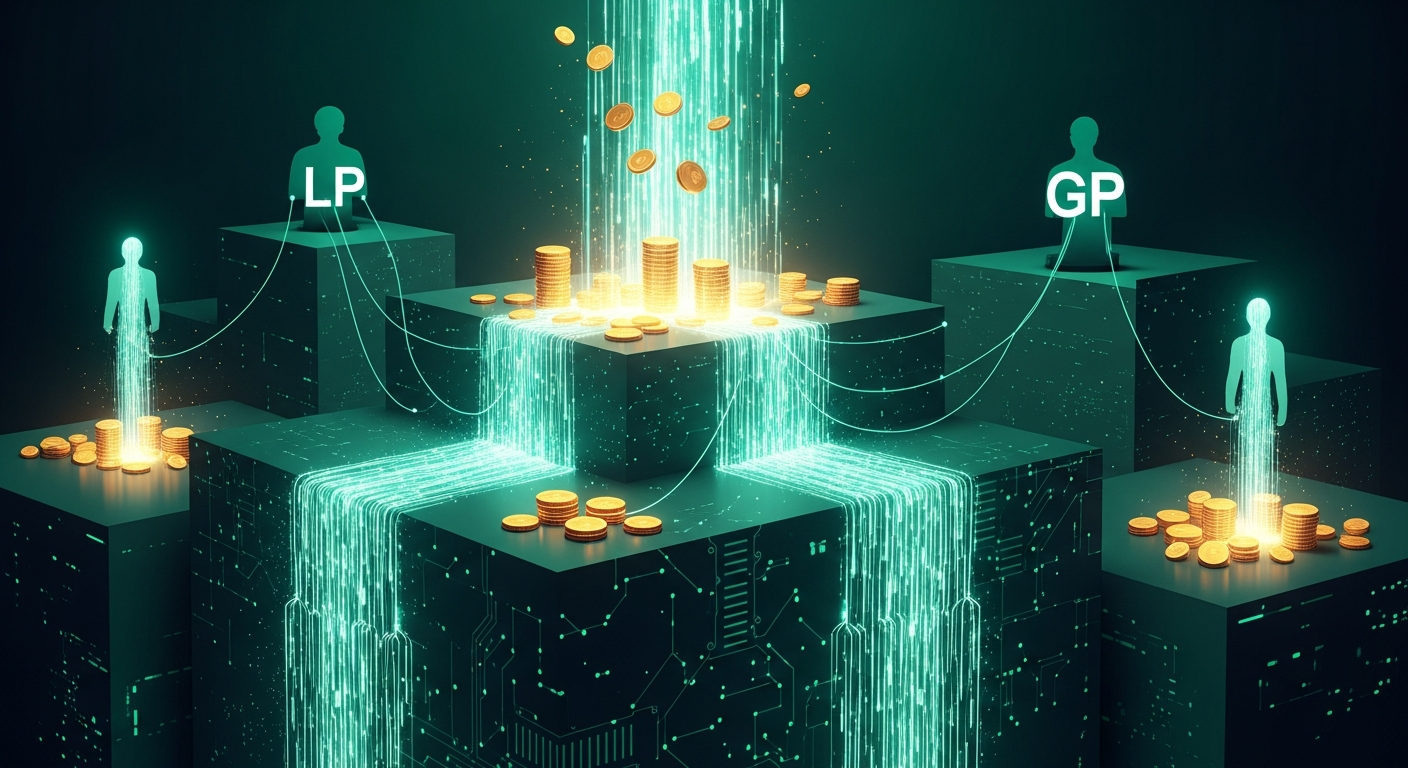
Venture capitalists wear two hats at once. With one, they pitch wealthy institutions to raise money; with the other, they invest that money in startups. But how does the machine actually work — and how do VCs themselves get paid? The answer reveals a carefully engineered structure of incentives, timelines, and mathematics that shapes every decision a venture firm makes: which startups get funded, how hard they're pushed, and when they're sold. Understanding venture capital fund mechanics isn't just for investors — for founders, it explains the logic behind term sheets, board pressure, and the relentless push for large outcomes.
This guide explains how VC funds are structured, who provides the money, how VCs make money through the "2 and 20" model, the distribution waterfall, the fund lifecycle, the power law that drives returns, and how performance is measured. (This is general educational information, not financial or investment advice.)
What Is a Venture Capital Fund?
A venture capital fund is a closed-end investment vehicle, typically structured as a limited partnership, that pools money from outside investors to invest in high-growth startups. Unlike a company, a fund has a finite life — usually around ten years — after which it must return capital to its investors. A single VC firm typically raises a series of funds over time (Fund I, Fund II, Fund III, and so on), each a separate pool with its own investors, timeline, and portfolio.
The entire structure is built around one relationship: the split between the people who provide the money and the people who invest it.
LPs and GPs: Who's Who
Two parties make up a VC fund. Limited Partners (LPs) are the passive investors who commit the capital — pension funds, university endowments, sovereign wealth funds, family offices, fund-of-funds, and wealthy individuals. Endowments were among the earliest and most successful backers of venture capital, and many institutions target allocating a portion of their portfolio (often in the range of 5–15%) to venture and other alternatives. LPs commit money but don't pick individual investments or run the fund; they're silent on operations and protected from liability beyond their committed capital — hence "limited."
General Partners (GPs) are the venture firm itself — the active managers who source deals, conduct due diligence, negotiate terms, sit on startup boards, decide which companies to back further, and ultimately steer toward exits. The GP makes all the investment decisions and, in return, earns the fund's fees and a share of its profits. This division — passive capital from LPs, active management by GPs — is what lets the GP move quickly while LPs stay hands-off.
How VCs Make Money: The "2 and 20" Model
VCs get paid two ways, captured in the industry shorthand "2 and 20":
- The management fee ("2") — traditionally about 2% of committed capital per year, paid by LPs to the GP regardless of performance. Crucially, this isn't profit or "free money": it covers the firm's entire operating cost — salaries, office, legal, due diligence, travel, and more. On a $200 million fund, 2% is $4 million a year to run the whole operation. Fees often step down (to around 1.5%) after the initial investment period, or shift to being charged on invested rather than committed capital. LP pressure has pushed many funds to negotiate lower fees.
- Carried interest ("20") — the GP's share of the fund's profits, standardly 20%. This is the real prize and the primary incentive. But it comes with conditions: carry is paid only after LPs have received their money back, and typically after clearing a "hurdle rate" (a preferred return, often around 8%) that LPs earn first.
The key insight: on a successful fund, the large majority of a GP's economics comes from carry tied to performance, not from guaranteed fees. That's what aligns the GP's incentives with the LPs' returns.
The Distribution Waterfall
When a fund's investments are sold and generate proceeds, the money is distributed according to a "waterfall" — a defined order of payouts spelled out in the fund's limited partnership agreement. Simplified, it flows like this: first, LPs get their invested capital back; second, LPs receive their preferred return (the hurdle); third, in a "catch-up," the GP receives a large share of the next profits until they've reached their agreed portion; and finally, remaining profits split between LPs and the GP at the carry ratio (typically 80/20). The waterfall ensures LPs are protected — the GP earns carry only after LPs are made whole and rewarded. Some funds use a "deal-by-deal" waterfall (carry calculated per exit), others use a "whole fund" waterfall (carry only after the entire portfolio is netted), with the latter being more LP-friendly.
The Fund Lifecycle and the J-Curve
A VC fund follows a predictable arc over its roughly ten-year life (sometimes extended to twelve or fourteen). The first several years are the investment period, when the GP deploys capital into new startups. The later years are the harvest period, when the GP supports companies toward exits — acquisitions or IPOs — and returns cash to LPs. Notably, LPs don't hand over all their money upfront; the GP draws it down over time through capital calls as investments are made.
This creates the famous J-curve: in the early years, a fund shows negative returns because fees are being paid and investments haven't yet been exited. Only later, as portfolio companies mature and exit, does the curve bend upward. In venture the J-curve is especially deep and long — meaningful cash distributions often don't begin until years five through eight. Patience is structural.
The Power Law: Why VC Works the Way It Does
The single most important concept in venture returns is the power law: a small number of investments generate the vast majority of a fund's profits. A typical early-stage fund might invest in 20 to 40 (or more) companies, fully expecting most to fail or return little — because the returns are driven by the one or two breakout winners that return 50x, 100x, or more, potentially carrying the entire fund. This dynamic explains almost everything about VC behavior: why VCs take big swings on ambitious startups, why they push for massive outcomes rather than safe small wins, why a 3x return on a small company is often less valuable than a 100x on a bigger swing. The math demands outliers. A fund that avoids losses but never finds a breakout winner is likely to underperform.
How Fund Performance Is Measured
LPs judge funds with a handful of standard metrics, each capturing a different dimension of returns:
- DPI (Distributions to Paid-In) — the most concrete: how much actual cash has been returned relative to what LPs put in. "Cash on cash."
- TVPI (Total Value to Paid-In) — total value including both distributions and the estimated value of companies still held.
- MOIC (Multiple on Invested Capital) — the overall multiple on invested money.
- Net IRR — the time-weighted annualized return, after fees and carry.
The best-performing venture funds have historically returned around 3x or more net to LPs, but dispersion is enormous — the gap between top-quartile and average funds is vast, which is why access to the best funds matters so much. Importantly, early-stage marks (TVPI) are subjective estimates until companies actually exit, which is why realized cash (DPI) carries special weight.
Skin in the Game and Alignment
To align interests, GPs are expected to invest their own money into the fund — the "GP commitment," often 1–5% of the fund's size. This "skin in the game" ensures the GP shares in losses as well as gains, not just collecting fees. A GP with meaningful personal capital at risk is more aligned with LP outcomes than one relying primarily on fee income. Between the GP commit, the carry structure, and the hurdle rate, the whole system is engineered to reward GPs mainly when LPs do well.
VC Fund Economics in 2026
The venture fund model is under real pressure in 2026. After the fundraising boom of the early 2020s and the subsequent slowdown, LPs have grown far more disciplined — pushing back on management fees, scrutinizing terms, and above all fixating on DPI. Amid a prolonged drought in IPOs and acquisitions, many funds have strong paper marks (TVPI) but little realized cash, and LPs increasingly want to see actual liquidity, not just optimistic valuations. This has made returning capital — not just marking up paper portfolios — the defining challenge for many firms. Fundraising for new funds has become harder as a result, with LPs committing more selectively to managers with proven track records of actual distributions.
Conclusion
Venture capital funds are elegant machines of aligned incentives: LPs provide the capital, GPs invest and manage it, and the "2 and 20" model — modest fees to operate, substantial carry to reward performance — ties everyone's fortunes together. A distribution waterfall governs who gets paid when, a ten-year lifecycle and deep J-curve demand patience, and the power law dictates that a few outlier winners drive nearly all returns.
Understanding this structure explains why VCs behave as they do — the big swings, the push for massive outcomes, the obsession with exits — and, in 2026, why they're newly focused on returning real cash to increasingly demanding LPs. For founders, knowing how the fund on the other side of the table actually works is a genuine advantage. As always, this is general information, not investment advice.
Want more? Explore AxionSquare for ongoing coverage of venture capital, startups, and the mechanics of funding innovation.
Frequently Asked Questions
How do venture capital funds work?
A VC fund is a closed-end limited partnership that pools money from investors (LPs) to invest in startups, managed by the venture firm (GP). It has a roughly ten-year life: the GP deploys capital in the early years, supports companies toward exits later, and returns proceeds to LPs. The GP earns management fees and a share of profits.
How do VCs make money?
Through the "2 and 20" model: a roughly 2% annual management fee on committed capital (which covers operating costs, not profit) plus 20% carried interest — the GP's share of the fund's profits. Carry is only paid after LPs get their capital back and clear a hurdle rate (often around 8%), making it a performance-based reward.
What is carried interest?
Carried interest, or "carry," is the general partner's share of a fund's investment profits — standardly 20%. It's the primary economic incentive for VCs, paid only after limited partners have recovered their invested capital and received a preferred return (hurdle). On a successful fund, carry makes up most of the GP's earnings.
What is the power law in venture capital?
The power law is the principle that a small number of investments generate the vast majority of a VC fund's returns. A fund may back 20–40+ companies expecting most to fail, because one or two breakout winners returning 50x or 100x can carry the entire portfolio. This drives VCs to take big swings on ambitious startups.
What is DPI and why does it matter in 2026?
DPI (Distributions to Paid-In) measures how much actual cash a fund has returned relative to what investors contributed — "cash on cash." It matters intensely in 2026 because a prolonged drought in IPOs and acquisitions has left many funds with strong paper valuations but little realized cash, so LPs are focused on real liquidity over optimistic marks.