Physical AI in 2026: The Brains Behind Robots
A clear guide to physical AI in 2026 — what it is, how it differs from generative AI, foundation models for robots, key players, applications, and the reality.
Robotics · Global · 2026-06-25 · 12 min read · By John Awab
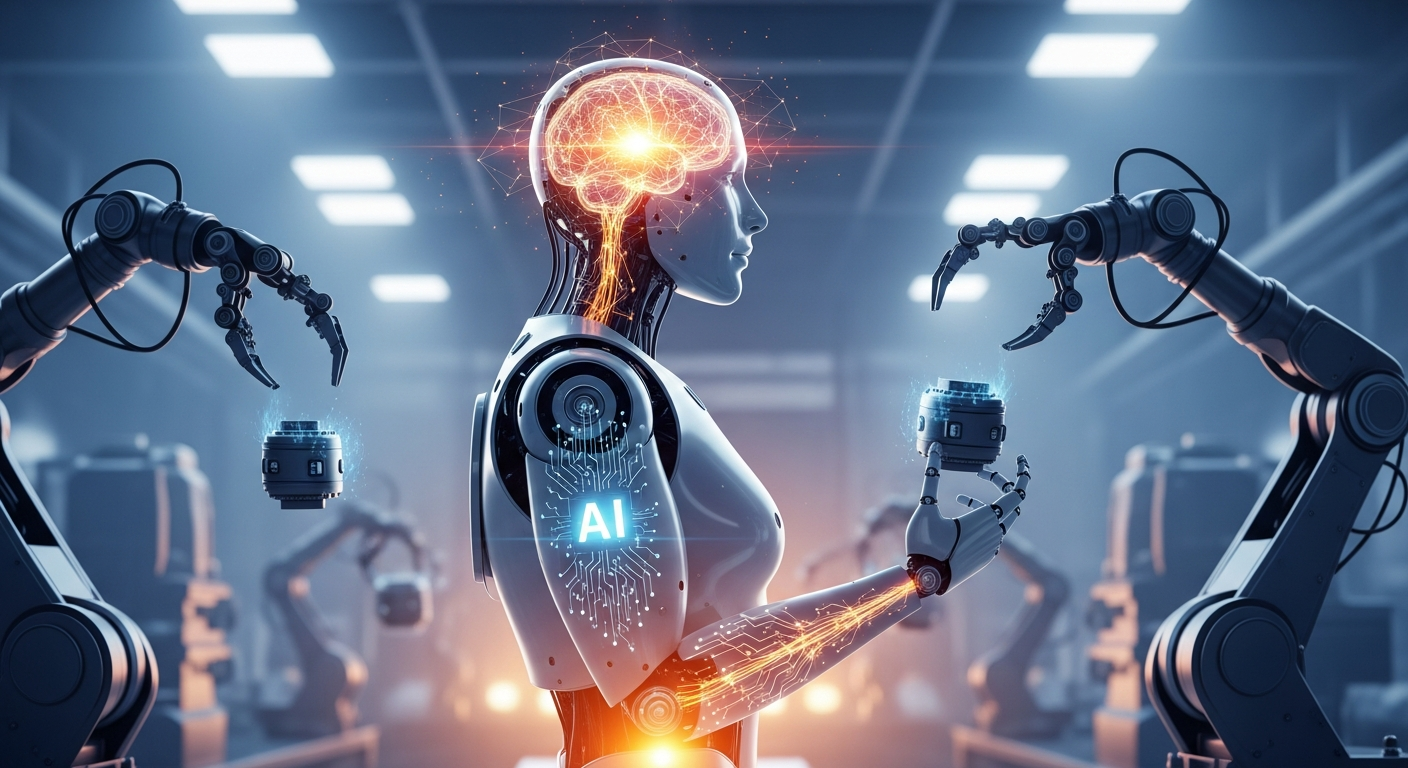
For years, robots were impressive but dumb — expensive machines that could repeat one precise task forever but fell apart the moment anything changed. In 2026, that's being upended by "physical AI": artificial intelligence that perceives, reasons about, and acts in the real world, giving robots something close to general-purpose intelligence. Industry leaders are calling it the "ChatGPT moment for robotics" and the next great platform shift after generative AI, with roughly $20 billion in investment flowing into the space.
This guide explains what physical AI is, how it differs from the generative AI behind chatbots, how it actually works, who's building it, what it powers, and an honest look at how far along it really is. (The field moves fast and figures come largely from industry sources with commercial interests, so treat specifics as a snapshot.)
What Is Physical AI?
Physical AI is artificial intelligence that operates in and interacts with the physical world — perceiving its surroundings, understanding and reasoning about them, and taking physical action. Where most AI lives entirely in software, physical AI is embodied: it controls machines that move, manipulate objects, and navigate real environments. It represents the convergence of three things — large-scale machine learning, realistic simulation, and robotics — into systems that can see, reason, and act.
The promise is to transform robots from costly, single-task, hard-to-program machines into "reasoning generalist-specialist" robots that understand instructions, adapt to new situations, and handle a variety of tasks — much as large language models turned narrow text tools into general-purpose assistants.
Physical AI vs Generative AI
The distinction is fundamental. Generative AI produces digital outputs — text, images, code, audio — that live on screens. Physical AI produces actions in the real world: a robot arm grasping an object, a humanoid walking across a factory floor, a machine adjusting to an obstacle it's never seen. This difference isn't just conceptual; it's an entirely different engineering discipline. Training a chatbot and training a robot have fundamentally different data pipelines, safety requirements, and feedback loops — a physical mistake can break something or hurt someone.
The Core Problem: Robots Don't Have the Internet
Here's the central challenge — and the key insight driving the field. Large language models learned from the vast text of the internet; image models learned from billions of online pictures. But there is no equivalent internet-scale dataset of robots performing physical tasks. Real-world robot data is slow, expensive, and dangerous to collect at scale.
The breakthrough idea is to convert this data problem into a compute problem. Instead of gathering scarce real-world data, developers generate enormous amounts of synthetic training data inside realistic simulations, running thousands of virtual robots in parallel to expose models to far more scenarios than physical robots ever could. Powerful GPUs and simulation platforms make this practical. In essence, the field trades a shortage of data for an abundance of computation — a trade that makes sense given how quickly compute is scaling.
How Physical AI Works
Several pieces come together to make a robot intelligent:
Foundation models for robotics. Just as LLMs are foundation models for language, new Vision-Language-Action (VLA) models are foundation models for robots. A VLA takes in what the robot sees (vision) and an instruction (language) and outputs physical actions — connecting perception to movement. Pre-trained on broad data, these models give robot developers a capable starting point to fine-tune for specific tasks, rather than programming every motion by hand.
World models. A newer class of "world foundation models" can generate realistic simulated environments and predict how actions play out, unifying world generation, visual reasoning, and action simulation to accelerate robot learning. These help robots understand physics and consequences.
Simulation and sim-to-real. Robots are trained largely in simulation — using reinforcement learning for skills like balancing and walking — then that learning is transferred to physical hardware, a process called sim-to-real. Combining massive simulated experience with some real-world data produces robust, general behaviors.
Onboard compute. Finally, robots need powerful, energy-efficient processors on the robot itself to run these AI models in real time, making split-second decisions without waiting on the cloud.
Key Concepts
A few terms anchor the field. Embodied AI (or embodied intelligence) is AI housed in a physical body that learns through interaction with the world. A VLA model maps vision plus language to action — the robotics analog of an LLM. Sim-to-real is the transfer of skills learned in simulation to physical robots. A generalist robot is one capable of many tasks and able to adapt, rather than being hard-coded for one. And whole-body control is the coordination of limbs, torso, and hands to accomplish tasks fluidly.
The Ecosystem and Key Players
A whole stack has emerged. NVIDIA has been central in popularizing "physical AI" as a category and provides much of the underlying infrastructure — simulation platforms, open foundation models, and the chips that both train the models and run on the robots — partnering with an ecosystem of well over a hundred robot developers. (It's worth noting NVIDIA's framing is commercially motivated, since it sells those GPUs, but it does capture a real convergence happening across the field.) Humanoid robot startups including Figure AI, Physical Intelligence (Pi), Agility Robotics, Boston Dynamics, and Unitree have emerged as key players, alongside industrial robot makers adding AI layers.
What Physical AI Powers
The applications span the robot world:
- Humanoid robots — the highest-profile target, aiming for general-purpose machines that work in factories, warehouses, and eventually homes.
- Industrial robots — traditional arms gaining AI that lets them handle variation and reprogram themselves rather than following rigid scripts.
- Mobile manipulators and autonomous mobile robots — machines that navigate and handle objects in logistics and manufacturing.
- Autonomous vehicles — self-driving systems are a form of physical AI, perceiving and acting in the real world.
- Specialized robots — across construction, agriculture, and more, gaining perception and reasoning.
The common thread is robots that adapt to messy, changing environments instead of demanding perfectly controlled ones.
The Reality Check
For all the excitement, honesty matters: physical AI is still early. Humanoid robots, the flashiest example, remain largely in controlled pilot environments rather than working freely on open factory floors, and the most capable demos can be far from reliable real-world deployment. The gap between what robots do in a lab and what they do in production is real — though notably, it appears to be closing faster than many expected as foundation models and training pipelines mature and compound on each other.
The Challenges
Several hurdles remain. Reliability and safety in unstructured, unpredictable environments are far harder than in controlled settings — and physical mistakes can hurt people or property. The reality gap between simulation and the real world must be carefully bridged. Generalization — getting a robot to handle truly novel situations — is still limited. Real-time onboard compute within a robot's power and size constraints is demanding. And cost remains high for both hardware and the compute needed to train and run the models, though both are falling.
The Future
The trajectory points toward more capable, general, and affordable robots. Expect rapidly improving foundation models, ever-better simulation, cheaper and more powerful onboard chips, and a steady march from pilots toward real deployments. Some envision a "Cambrian explosion" of robotics as the technology matures — a proliferation of intelligent machines across industries and eventually daily life. Whether that arrives this decade or takes longer, the direction is set: robots are moving from tools to collaborators.
Conclusion
Physical AI is the intelligence layer transforming robotics — embodied artificial intelligence that perceives, reasons, and acts in the real world, turning rigid single-task machines into adaptable, reasoning robots. By solving robotics' data scarcity with simulation and compute, and by building foundation models like VLAs that connect vision and language to action, the field is delivering what many call the "ChatGPT moment for robotics."
The hype is real but so are the limits: humanoids and general-purpose robots remain early, with safety, reliability, and generalization still to be conquered. Yet the lab-to-reality gap is closing faster than expected, and a powerful ecosystem of chipmakers, startups, and industrial giants is racing forward. Understanding physical AI — the brains now being installed in machines — is key to grasping where robotics, and much of the physical economy, is headed.
Want more? Explore AxionSquare for ongoing coverage of physical AI, humanoid robots, and the technologies bringing intelligent machines to life.
Frequently Asked Questions
What is physical AI?
Physical AI is artificial intelligence that perceives, reasons about, and acts in the physical world, controlling machines like robots. Unlike software-only AI, it's "embodied" — it moves, manipulates objects, and navigates real environments, combining large-scale learning, simulation, and robotics into systems that can see, think, and do.
How is physical AI different from generative AI?
Generative AI produces digital outputs like text and images that live on screens, while physical AI produces actions in the real world — a robot grasping an object or walking across a room. The physical world is messy and unforgiving, requiring fundamentally different data, compute, and engineering than training a chatbot.
What is a VLA (Vision-Language-Action) model?
A VLA model is a foundation model for robots, analogous to a large language model for text. It takes in what a robot sees (vision) and an instruction (language) and outputs physical actions, connecting perception to movement so robots can be fine-tuned for tasks rather than programmed motion by motion.
Why is simulation so important for physical AI?
There's no internet-scale dataset of robots performing tasks, and real-world robot data is slow and costly to collect. Simulation solves this by generating massive synthetic training data, running thousands of virtual robots in parallel — effectively converting robotics' data problem into a compute problem that powerful GPUs can handle.
How advanced are AI robots in 2026?
Physical AI is a genuine breakthrough but still early. Humanoid robots largely remain in controlled pilot environments rather than working freely in real factories, and reliability, safety, and generalization remain challenges. However, the gap between lab capability and real-world deployment is closing faster than many expected.