Surgical Robots in 2026: Robotic Surgery Explained
A clear guide to surgical robots in 2026 — how robotic surgery works, the benefits, da Vinci and its rivals, costs, the autonomy question, and what's next.
Robotics · Global · 2026-07-02 · 11 min read · By John Awab
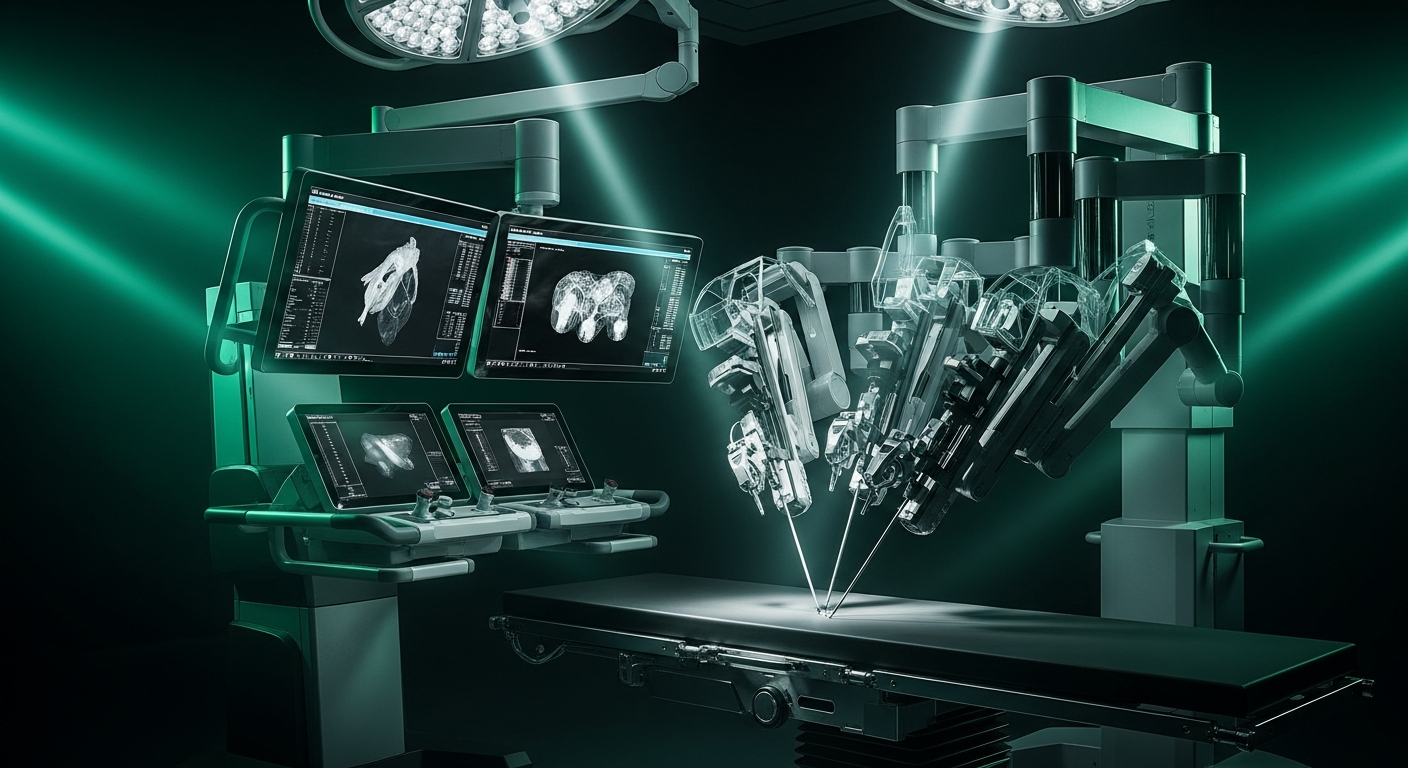
A surgeon sits at a console a few feet from the patient, hands on controls, eyes on a magnified 3D view. As the surgeon's wrists move, robotic arms inside the patient translate those motions into precise, tremor-free actions through incisions just millimeters wide. This is robotic surgery, and it has quietly become mainstream: in a single recent year, more than 2.7 million procedures were performed on da Vinci systems alone, part of nearly 17 million to date. What began 25 years ago as an experimental novelty is now a standard tool across hospitals worldwide — and in 2026, a wave of new competitors and AI-driven capabilities is reshaping the field.
This guide explains what surgical robots are, how robotic surgery works, its benefits, the key players, the costs, the autonomy question, and where the technology is heading. (This is general educational information about technology, not medical advice; consult qualified healthcare professionals for any medical decision.)
What Are Surgical Robots?
Surgical robots are computer-controlled systems that assist surgeons in performing minimally invasive procedures with enhanced precision, dexterity, and control. The accurate term is "robotic-assisted surgery," because these systems don't operate on their own — a human surgeon controls every movement. What the robot adds is capability: it translates the surgeon's hand motions into scaled, tremor-filtered, highly precise instrument movements, offers 3D high-definition visualization, and allows a range of motion beyond the human wrist, all through tiny incisions.
In essence, a surgical robot is a sophisticated extension of the surgeon's hands and eyes — not a replacement for the surgeon's judgment, but a tool that makes complex minimally invasive operations more precise and less traumatic.
How Robotic Surgery Works
A typical robotic surgery system has three main parts. The surgeon console, where the surgeon sits and controls the procedure while viewing a magnified 3D image. The patient-side cart, which holds the robotic arms and the surgical instruments that enter the patient. And the vision cart, housing the camera and processing systems. The surgeon's movements at the console are captured and translated in real time into the instruments' movements inside the body — scaled down for precision and filtered to remove hand tremor.
Underneath, these systems run on millions of lines of code. One elegant example: when a laparoscopic instrument enters the body through a small incision, the system automatically pivots it around that entry point to minimize tissue trauma — handling one of the most cognitively demanding aspects of minimally invasive surgery so the surgeon can focus on the operation itself.
A Brief History
The idea of computer-assisted surgery dates to the 1970s and 1980s, with early experimental robots used in neurosurgery and prostate procedures. The watershed moment came in 2000, when Intuitive Surgical's da Vinci system received FDA clearance, combining tele-operated robotic arms with enhanced 3D vision and revolutionizing minimally invasive surgery. Early models had three arms; a four-arm version followed in 2002. Today, the latest generation — da Vinci 5 — advances imaging, dexterity, ergonomics, and AI integration, while a growing field of competitors pushes the technology forward. Over 25 years, robotic surgery evolved from novelty to mainstream practice.
The Benefits
The advantages driving adoption are substantial. For patients, robotic-assisted surgery typically means smaller incisions, less blood loss, reduced pain, shorter hospital stays, faster recovery, and fewer complications. Clinical studies bear this out — for example, comparisons in colorectal cancer surgery found robotic-assisted patients experienced significantly fewer complications and shorter stays than open surgery. For surgeons, the technology offers enhanced dexterity, motion scaling, tremor reduction, superior 3D visualization, better ergonomics, and reduced fatigue during long procedures. Conversion rates to open surgery are low, and infection and major-complication rates are generally low. These combined benefits explain why robotic surgery has spread rapidly across specialties.
The Market and Key Players
The surgical robotics market is large and growing — estimated at roughly $8–9 billion in the mid-2020s and projected to reach the mid-teens of billions by the early 2030s, growing at low-double-digit rates, though figures vary widely by scope. North America dominates adoption, while Asia-Pacific is the fastest-growing region.
Intuitive Surgical remains overwhelmingly dominant, with its da Vinci platform commanding roughly two-thirds or more of the market — over 10,000 systems installed across 70+ countries and around 17 million procedures performed. But 2026 marks intensifying competition:
- Medtronic's Hugo is a modular, mobile-cart system positioned as a lower-cost, flexible alternative, which recently gained US clearance for urologic procedures and is pursuing more indications.
- CMR Surgical's Versius (UK) offers a portable, scalable design, used across Europe and India.
- Johnson & Johnson's Ottava entered clinical use for soft-tissue surgery, and its Monarch platform serves bronchoscopy.
- In orthopedics — a distinct segment — Stryker's Mako and Zimmer Biomet's ROSA dominate robotic joint and spine procedures with CT-based planning and sub-millimeter accuracy.
- Chinese players like MicroPort MedBot (a telesurgery leader) and SS Innovations are expanding globally, with some seeking US clearance.
The field is splitting into large multinationals challenging Intuitive head-on and smaller companies differentiating in specialized niches.
Where Surgical Robots Are Used
Robotic surgery is most established in urology (prostatectomy is among the most common robotic procedures), gynecology, and general surgery, and it's expanding into colorectal, bariatric, hernia repair, cardiothoracic, and head-and-neck procedures. A notable 2026 push is into cardiac surgery, where advanced imaging, motion control, and AI could help address unmet needs. Orthopedic robotics (joint replacement, spine) forms a large parallel category. Adoption is also spreading to new sites of care, including outpatient and ambulatory surgery centers, which value the precision and faster recovery.
The Cost Problem
The biggest barrier to robotic surgery is cost. A da Vinci system can cost roughly $1.5–2.5 million to purchase, with annual maintenance, service, and disposable instruments adding another $100,000–300,000 per year. This high price both limits adoption (especially for smaller and mid-sized hospitals) and creates a barrier to entry that has historically protected the market leader. It also complicates the value proposition: reimbursement models aren't standardized, and some surgeons find robotic procedures slower or costlier per case for certain operations, meaning the technology isn't right for every specialty or setting. Newer competitors are responding with modular, portable, and more affordable systems designed to lower these barriers.
What's New in 2026
Several trends are reshaping the field. Single-port systems perform surgery through just one small incision, improving cosmetic results and recovery. Telesurgery — operating robots remotely across distances — is advancing, potentially extending expert surgical care to underserved regions. AI integration is a major theme: real-time decision support, video replay to inform intraoperative choices, force-feedback sensing tissue pressure, and performance analytics are being built into systems. Further out, digital surgical twins and augmented reality overlays promise to enhance planning and guidance. And competition is driving rapid innovation across all these fronts as companies race to differentiate.
Are Surgical Robots Autonomous?
This is a crucial point often misunderstood: today's surgical robots are not autonomous. They are fully controlled by human surgeons — the robot executes the surgeon's movements but makes no independent decisions about the operation. Despite advancing AI, no fully autonomous surgical system exists, and these systems are expected to remain human-dependent for the foreseeable future. Research is exploring semi-autonomous subtasks, and AI is increasingly providing decision support, but the surgeon remains firmly in control. This raises important questions as AI grows more capable — including who bears responsibility if an AI system advises a risky move — but for now, robotic surgery firmly keeps a human in command.
The Challenges
Beyond cost, robotic surgery faces real challenges. The steep learning curve requires significant surgeon training and experience. Reimbursement remains inconsistent, with no standardized payment model across markets. The clinical evidence for robotic superiority varies by procedure — some studies find comparable rather than better outcomes versus other minimally invasive techniques, and it isn't beneficial for every specialty. Cybersecurity is an emerging concern for these connected, software-driven systems. And regulatory pathways for new indications and AI features are still evolving. Navigating these — especially cost and evidence — is central to responsible, sustainable adoption.
The Future
Robotic surgery's trajectory points toward broader access, more capability, and smarter systems. Expect continued competition to lower costs and expand options, further AI integration for guidance and analytics, growth into new specialties like cardiac surgery, wider telesurgery and single-port adoption, and steady incremental advances in autonomy for specific subtasks — always with human oversight. As the technology becomes more affordable and capable, robotic-assisted surgery is likely to become the default for an ever-wider range of minimally invasive procedures, extending precise surgical care to more patients and more places.
Conclusion
Surgical robots have transformed the operating room — giving surgeons enhanced precision, dexterity, and visualization to perform minimally invasive procedures that mean smaller incisions, faster recovery, and fewer complications for patients. Pioneered by Intuitive Surgical's da Vinci and now challenged by a growing field of competitors, robotic surgery has become mainstream, performing millions of procedures a year across urology, gynecology, orthopedics, and beyond.
Real challenges remain around cost, evidence, and reimbursement, and it's essential to understand that these systems assist rather than replace surgeons — they are not autonomous. As competition, AI, telesurgery, and new specialties expand the field in 2026 and beyond, surgical robots are set to bring precise, minimally invasive care to ever more patients. As always, this is general information, not medical advice — consult qualified healthcare professionals for your care.
Want more? Explore AxionSquare for ongoing coverage of surgical robots, physical AI, AI in healthcare, and the technologies transforming medicine.
Frequently Asked Questions
What are surgical robots?
Surgical robots are computer-controlled systems that assist surgeons in performing minimally invasive procedures with enhanced precision, dexterity, and 3D visualization. The accurate term is "robotic-assisted surgery" because a human surgeon controls every movement — the robot translates the surgeon's hand motions into scaled, tremor-free instrument movements through tiny incisions.
How does robotic surgery work?
The surgeon sits at a console viewing a magnified 3D image and controls robotic arms mounted on a patient-side cart. Their hand movements are captured and translated in real time into the instruments' movements inside the body — scaled for precision and filtered to remove tremor — while the system automatically minimizes tissue trauma at the incision points.
What are the benefits of robotic surgery?
For patients, benefits typically include smaller incisions, less blood loss and pain, shorter hospital stays, faster recovery, and fewer complications. For surgeons, it offers enhanced dexterity, motion scaling, tremor reduction, superior 3D visualization, and reduced fatigue. Clinical studies show favorable outcomes for many procedures, though benefits vary by operation.
Are surgical robots autonomous?
No. Today's surgical robots are fully controlled by human surgeons and make no independent decisions — no fully autonomous surgical system exists, and they're expected to remain human-dependent for the foreseeable future. AI is increasingly providing decision support and research explores semi-autonomous subtasks, but the surgeon stays in control.
Which companies make surgical robots?
Intuitive Surgical's da Vinci dominates the market with over 10,000 systems installed. Competitors include Medtronic (Hugo), CMR Surgical (Versius), and Johnson & Johnson (Ottava) in soft tissue; Stryker (Mako) and Zimmer Biomet (ROSA) in orthopedics; and Chinese players like MicroPort MedBot and SS Innovations expanding globally.